Call it the nineteenth century print culture sublime: an overpowering
miscellany of reprinted and newly-circulated works that included, among
many other new kinds of images and genres, works as diverse as religious
publications, secular celebrity forms, and fashion plates. British
Writers, Popular Literature and New Media Innovation offers the
pleasure of confronting that sublime through a series of case studies
circumscribed by a particular period, 1820-1845, which Alexis Easley
characterizes as one "of new media innovation, an era that produced a
wide variety of book, periodical, and newspaper formats that were
available to a larger and more diversified reading public than ever
before" (1). Its account of innovation is also an account of adaptation,
tracing how familiar forms changed shape and how new media forms drew on
established ones.
Easley's introduction to the volume is an engaging overview of the
many facets of nineteenth-century print culture and an ideal
foundational text for studying the period. It contextualizes the new
media forms under discussion by referencing industrial changes to
artistic production, and it addresses historical social changes that
created new readers: "rather than simply harnessing existing audiences,
the popular press constructed the mass and niche readerships that would
consume print" (5). Innovation "included experimentation with new
publication formats, the reinvention and remediation of older forms, and
the definition of new kinds of contributors and audiences for print"
(6).
Jennie Batchelor's "Keeping 'pace with the growing spirit of the
times': The Women's Magazine in Transition" is a particularly clear
example of how "innovation" entails both adapting to new popular forms
like the literary annual and reviving older elements like reader
dialogue and advice columns. She opens with a consideration of The
Lady's Magazine, a periodical that both did and did not transform
to compete in a radically different marketplace. The essay looks
backward, to the periodical's initial innovative appeal to all women,
"from the 'house-wife' to the 'peeress'" (160), as a Romantic-era
magazine active during the "vibrant decades of the 1820s and 1830s"
(172). However, Batchelor's essay also looks forward, describing how
The Lady's Magazine evolved an "increasingly close
relationship" to literary annuals, both in reprinting content and by
"marriage" to The Companion to the Annuals. The essay even
draws our attention to an innovation in the distribution of images, in
which the Magazine struck a deal with the Parisian fashion
magazine Le Follet to reprint fashion plates directly from
Paris (169, 170).
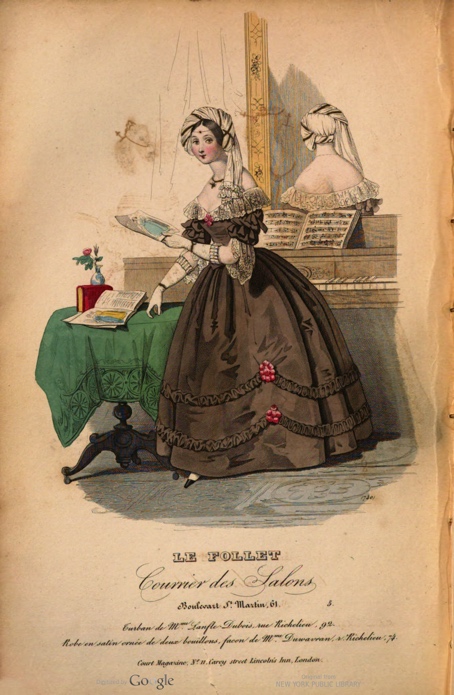
A woman in a turban "of Indian muslin wrought in gold" who is both
looking at a fashion plate and being one.
"The Court Magazine & Monthly Critic and Lady's Magazine, & Museum of the Belles Lettres,
Music, Fine Arts, Drama, Fashions, &c.,"
Court Magazine and
Monthly Critic and Lady's Magazine, 1838, 32 v. HathiTrust.
Françoise Baillet's essay, "Invincible Brothers: The Pen and the
Press in The Compositors' Chronicle, 1840--43," shows how one
consequence of the reduction of the stamp duty in 1836 was "a considerable growth of specialised periodicals and thus a
segmentation of reading audiences." Baillet takes up a trade journal
that was typical in its format and also aimed at compositors, including
puns and in-jokes about printing. Popular literature in the volume
includes "so-called 'popular' writers and editors such as Dinah Mulock,
Mary Howitt and Charles Knight, who addressed broad readerships" through
new media forms--"annuals, trade magazines, Sunday papers, cheap weekly
periodicals, and illustrated books and magazines" (7). Brian Maidment
considers the development of the ideas of "Mirth" and "Fun" in the comic
annual and the "New Graphic Humour" of the 1830s, including the work of
Robert Seymour. In "Fauna, Flora and Illustrated Verse in Mary Howitt's
Environmental Children's Poetry," Linda K. Hughes argues that Howitt's
environmental poetry in the children's gift book, Sketches of
Natural History, anticipates an ecocritical decentering of
humans.
The volume also includes reflections on canonical writers like Thomas
Carlyle, Elizabeth Barrett Browning, Letitia Landon, and William Hazlitt
(7-8). These figures emerge quite differently when considered through
the lens of new media forms. Chris Haffenden's "William Hazlitt and
Celebrity Culture: Periodical Portraits in an Age of Public Intimacy"
shows how Hazlitt critiqued celebrity culture but also traded in its
print forms. Even though Hazlitt refused to include visual portraits in
The Spirit of the Age, the gallery of figures includes personal
details. In "Literature, Media and the 'Advertising System'," Richard
Salmon uses the broader history of advertising in the 1840's to connect
the idea of the "cure-all" that appears in Carlyle's Past and
Present with advertisements in the Chartist weekly, The
Northern Star. Elizabeth Howard considers LEL and EBB on Hemans in
the The New Monthly Magazine in 1835 as part of an intertwined
women's literary tradition and also as part of the magazine's effort to
capitalize on her death. In "Beyond the Literary Annuals: Felicia
Hemans, Letitia Elizabeth Landon and Periodical Poetry," Caley Ehnes
considers "why reprinted poetry mattered to the editors and readers" of
new forms like the family literary periodical emerging in the 1830s and
shows how that context "suspends and intensifies the public narratives
that grew around [Hemans and Landon] (189, 180).
Two essays connect new print forms with social relations. In "A
Familiar Transition: Dinah Mulock Craik's Early Career in Periodicals,
1841--5," Helena Goodwyn gives shape to the idea of new media forms by
considering published songs in context of performance--and how Craik
"networked, rewrote, reinterpreted, reimagined, translated, performed,
and socialised" her way into literary prominence (213). Sara L. Maurer's
"The Media System of Charitable Visiting" shows media at work in
organized charitable visiting, in which tracts worked like tickets to
facilitate communication and "blanks" designed to track the visit
allowed print to mediate social relations. Moreover, visitors were
imagined as representing the pastor in a disciplined way in order to
ensure wise use of resources, in a context in which the poor "complex
texts to be read" (259).
In "Paratextual Navigation: Positions of Witnessing in The
Anti-Slavery Reporter," Sofia Prado Huggins suggests that footnotes
worked to "spatialize" a reader's attention, calling that attention away
from Black experience and toward white witness-for example, in the
internal challenge to a proslavery petition from London in regard to the
West Indies. In "'Collect and Simplify': Serial Miscellaneity and
Extraction in the Early Nineteenth Century," Mark Turner considers what
he calls "extractive miscellaneity" in the early nineteenth centuries to
understand how literary bits might be collected like "scraps" but also
as "kernels" or "essential bits" in the context of serial publication
and global systems of circulation (19, 26). His discussion of the
Australian Magazine; or, Compendium of Religious, Literary, and
Miscellaneous Intelligence shows how it connected with and
reflected particular global contexts--in relation to the imperial center
but also to other colonial sites (31).
British Writers, Popular Literature and New Media Innovation
is especially welcome given the cultural publishing context at time of
writing, which could be characterized in terms of what New York
Magazine has called a "Media Apocalypse." The period of new media
innovation it examines was certainly a time of invention and adaptation,
but it was also an extinction event. In that time of rapid material and
cultural change, cultural producers created new or newly-composite forms
that would create readers and make money. This captivating collection of
case studies serves as an invitation to further research in its
explorations of figures and texts that will be new to many readers, but
also in its investigation of the interconnected relations between
authors, readers, publishers, and new media forms.
Sarah Allison is Associate Professor of English and Hutchinson
Distinguished Professor at Loyola University New Orleans.
